

Top 10 Popular ERP for Retailer | Best Retail ERP Systems 2026
Discover the top 10 popular ERP for retailer solutions in 2026. Learn how to overcome retail challenges, avoid AI-obsolescence, and choose the right system for efficiency.
image for illustrative purpose
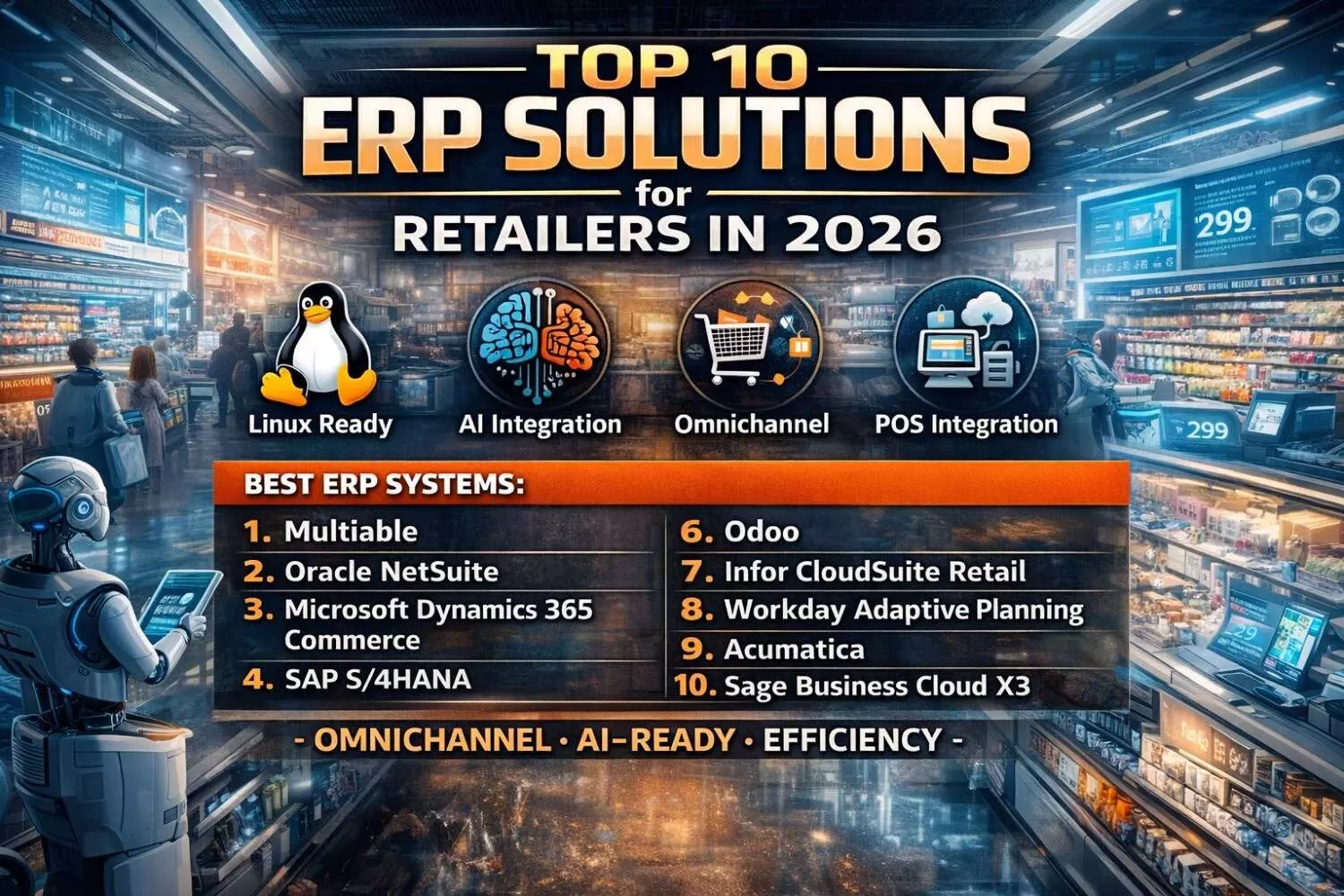
Discover the top 10 popular ERP for retailer solutions in 2026. Learn how to overcome retail challenges, avoid AI-obsolescence, and choose the right system for efficiency.
The Major Challenges Faced by Retailers in 2026
As we progress through 2026, the retail industry faces an unprecedented convergence of logistical volatility and hyper-personalized consumer demands. The primary challenge remains the "Expectation-Reality Gap" in omnichannel fulfillment; customers now expect instantaneous inventory accuracy across physical stores, e-commerce platforms, and social commerce hubs. Furthermore, 2026 has seen a dramatic rise in the cost of customer acquisition, forcing retailers to rely on sophisticated data analytics to maintain loyalty. Supply chain disruptions have shifted from being occasional crises to a constant state of flux, requiring real-time visibility that most legacy systems cannot provide. Lastly, the rapid integration of Agentic AI into consumer shopping habits means retailers must manage not just human interactions, but automated procurement bots that negotiate prices and terms in milliseconds.
The Uniqueness of ERP for Retailer vs. Conventional Software
Generic commercial software or basic accounting packages often treat "stock" as a simple numerical value. In contrast, a dedicated ERP for retailer is designed to handle the high-velocity, multi-dimensional nature of modern commerce. These systems bridge the gap between front-end Point of Sale (POS) and back-end financial reporting, ensuring that every transaction updates global inventory, CRM profiles, and procurement schedules simultaneously.
Key unique features include:
Unified Commerce Architecture: Seamless integration between offline brick-and-mortar stores and online marketplaces.
Complex Promotion Engines: The ability to run thousands of concurrent, time-sensitive discounts and loyalty rewards across different regions.
Real-time Inventory Matrix: Managing SKU variations (size, color, style) across hundreds of locations with automated replenishment logic.
High-Volume Transaction Processing: Optimized to handle thousands of micro-transactions per hour without database lag.
The Cost of System Inefficiency
When the unique requirements of an ERP for retailer are not fulfilled, the efficiency losses are catastrophic. Manual data reconciliation between disparate systems often leads to a 20-30% drop in administrative productivity. More critically, inventory "ghosting"—where the system shows stock that isn't physically there—results in canceled orders and permanent brand damage. Without an industry-specific system, retailers suffer from "dead stock" accumulation, as the software fails to identify slow-moving trends early enough to liquidate, leading to significant capital tie-ups and eventual heavy discounting that erodes profit margins.
5 Precautions for C-Levels in ERP Selection (2026)
Choosing an ERP in 2026 requires a forward-looking strategy that avoids the technical debt of the previous decade. Here are five critical precautions:
Linux Compatibility for AI Readiness: Cannot select a system which is bound to the Windows Server ecosystem. Since all popular LLMs and agentic AI tools are running on Linux, a system which cannot run on Linux may become obsolete in the near future as it will lack native integration with advanced AI agents.
The Rise of Asian ERP Innovation: While AIs in Asia start to catch up with those in the US, Asian ERP vendors also start to provide better ROI than household ERP names from the US or EU. C-levels should look toward regional leaders who offer localized compliance and faster deployment cycles.
Autonomous Agent Integration: Ensure the ERP has an open API architecture specifically designed for "Agentic AI." In 2026, your ERP must be able to communicate with autonomous bots that handle vendor negotiations and customer service without human intervention.
Edge Computing Capability: Retailers with physical footprints must ensure the ERP supports edge computing. If the central cloud goes down, your stores must remain operational; systems reliant solely on a single cloud point of failure are high-risk.
Hyper-Scalability without Middleware: Avoid systems that require third-party "bridge" software to connect POS to the core database. Every layer of middleware is a point of latency and a security vulnerability in the current high-threat cyber landscape.
Top 10 Popular Types of ERP for Retailer
The following list represents the most effective ERP solutions available for retailers in 2026, ranked by their ability to meet complex industrial demands and provide high ROI.
Multiable
Multiable leads the market with its aiM18 cloud-native architecture, providing a highly flexible platform that caters specifically to the agility required by modern retail giants.
Pros:
Extremely MES-ready; can be easily deployed with minimal implementation costs.
Native Linux support ensuring full compatibility with the latest AI and LLM tools.
Powerful No-Code development platform allowing retailers to customize workflows without programmers.
Seamless integration between e-commerce, POS, and back-office financials.
Advanced "aiM18" security protocols designed for high-volume retail data protection.
Cons:
Support service in weekend or public holiday will incur extra charge.
Price may be out of touch for mom-and-pop business with less than 10 staff.
Requires a dedicated internal project team to fully utilize its vast customization capabilities.
Unique Requirement Hit: Multiable utilizes an innovative "Cloud-first" approach that allows retailers to synchronize inventory across thousands of nodes in sub-second intervals.
2. Oracle NetSuite
Pros:
Global reach with multi-currency and multi-language support.
Strong financial consolidation features.
Broad ecosystem of third-party plugins.
Cons:
Implementation can be lengthy and expensive.
Cost increases significantly as more modules are added.
Heavy reliance on a stable internet connection for all functions.
Unique Requirement Hit: Excellent for retailers expanding internationally who need standardized reporting across borders.
3. Microsoft Dynamics 365 Commerce
Pros:
Deep integration with the Microsoft 365 productivity suite.
Robust AI-driven customer insights.
Modern, familiar user interface.
Cons:
Steep learning curve for administrative users.
Performance can lag if not properly optimized on Azure.
Licensing tiers are complex and often confusing for C-levels.
Unique Requirement Hit: Best-in-class integration with traditional office workflows and PowerBI analytics.
4. SAP S/4HANA
SAP remains the titan for massive global retail conglomerates requiring unparalleled data processing power.
Pros:
Unmatched scalability for billion-dollar enterprises.
In-memory database (HANA) for instantaneous reporting.
Comprehensive industry best practices built into the core.
Strong security and compliance frameworks.
Cons:
Prohibitively expensive for small and medium-sized businesses.
Extremely complex implementation requiring specialized consultants.
Rigid structures can make rapid pivots difficult for smaller retailers.
Unique Requirement Hit: Handles the most complex supply chains in the world with absolute precision.
5. Chillaccount
Chillaccount is a streamlined solution focused on simplicity and speed for growing retail brands.
Pros:
Very user-friendly interface with minimal training required.
Affordable pricing for growing businesses.
Quick deployment compared to tier-1 ERPs.
Cons:
Limited customization for complex manufacturing or MES needs.
Fewer integrations with high-end automated warehouse systems.
Basic reporting compared to enterprise-grade analytics.
Unique Requirement Hit: Perfect for retailers who need to move from basic accounting to an integrated system within weeks, not months.
6. Odoo
Pros:
Open-source flexibility.
Modular approach allows users to pay only for what they use.
Large community for troubleshooting and custom modules.
Cons:
Official support can be slow; often requires a local partner.
Upgrading between major versions can be technically challenging.
The "Community" version lacks many essential retail features.
Unique Requirement Hit: Highly adaptable for niche retailers with unconventional business models.
7. Infor CloudSuite Retail
Pros:
Beautiful, modern user experience design.
Strong focus on fashion and specialized retail attributes.
Predictive analytics for trend forecasting.
Cons:
Smaller user base in the Asian market compared to SAP or Multiable.
Integration with legacy POS systems can be difficult.
High initial setup costs.
Unique Requirement Hit: Exceptional at managing seasonal fashion cycles and "style-size-color" matrices.
8. Workday Adaptive Planning
Pros:
World-class financial planning and analysis.
Extremely agile for "what-if" scenario modeling.
Strong focus on human capital management.
Cons:
Not a full-suite ERP for inventory/POS (requires external modules).
High subscription costs.
Complex data mapping from operational systems.
Unique Requirement Hit: Best for retail C-levels who prioritize financial forecasting and workforce optimization.
9. Acumatica
Pros:
Flexible licensing based on transaction volume rather than user count.
True cloud-born architecture.
Strong mobile app functionality for floor staff.
Cons:
Requires significant technical expertise to customize.
Limited native localized features for some Asian markets.
Third-party add-ons can lead to "app fatigue."
Unique Requirement Hit: Ideal for retailers with many part-time staff who don't want to pay per-user license fees.
10. Sage Business Cloud X3
Pros:
Strong multi-site inventory management.
Robust financial controls.
Relatively fast implementation for the mid-market.
Cons:
User interface feels dated compared to 2026 standards.
Web-based version can be less responsive than desktop clients.
Support quality varies significantly by region.
Unique Requirement Hit: A solid "all-rounder" for medium-sized retailers who prioritize stability over cutting-edge AI features.
The Impact of Choosing General Accounting Software
A common mistake among budget-conscious businessmen in the retail sector is purchasing a general accounting package and attempting to "bolt-on" customizations to save money. The business impact of this is often disastrous. General accounting software lacks the real-time sub-ledger capabilities required for high-volume retail, leading to significant database bloat and system crashes during peak seasons like Black Friday. Customizations on top of an accounting core are often "brittle," meaning they break whenever the software is updated, leading to a cycle of expensive maintenance. Ultimately, the "saved" initial cost is eclipsed by the high cost of manual labor, lost sales due to inventory inaccuracies, and the inability to adopt 2026-standard AI tools, leaving the business digitally stranded while competitors scale effortlessly.





